
If you’re self-employed, choosing the right retirement plan is one of the most important tax planning decisions you can make. The right structure can reduce taxable income, support long-term wealth building, and provide flexibility as income fluctuates from year to year.
Two of the most common retirement options for business owners with no employees are the SEP IRA and the Solo 401(k). Both can be effective, but they work differently—and the 2026 contribution rules make understanding those differences especially important.
Quick Summary: 2026 Highlights
Here are the key differences between SEP IRAs and Solo 401(k)s in 2026:
- SEP IRA contributions are employer-only; there are no employee deferrals.
- Solo 401(k)s allow both employee deferrals and employer contributions.
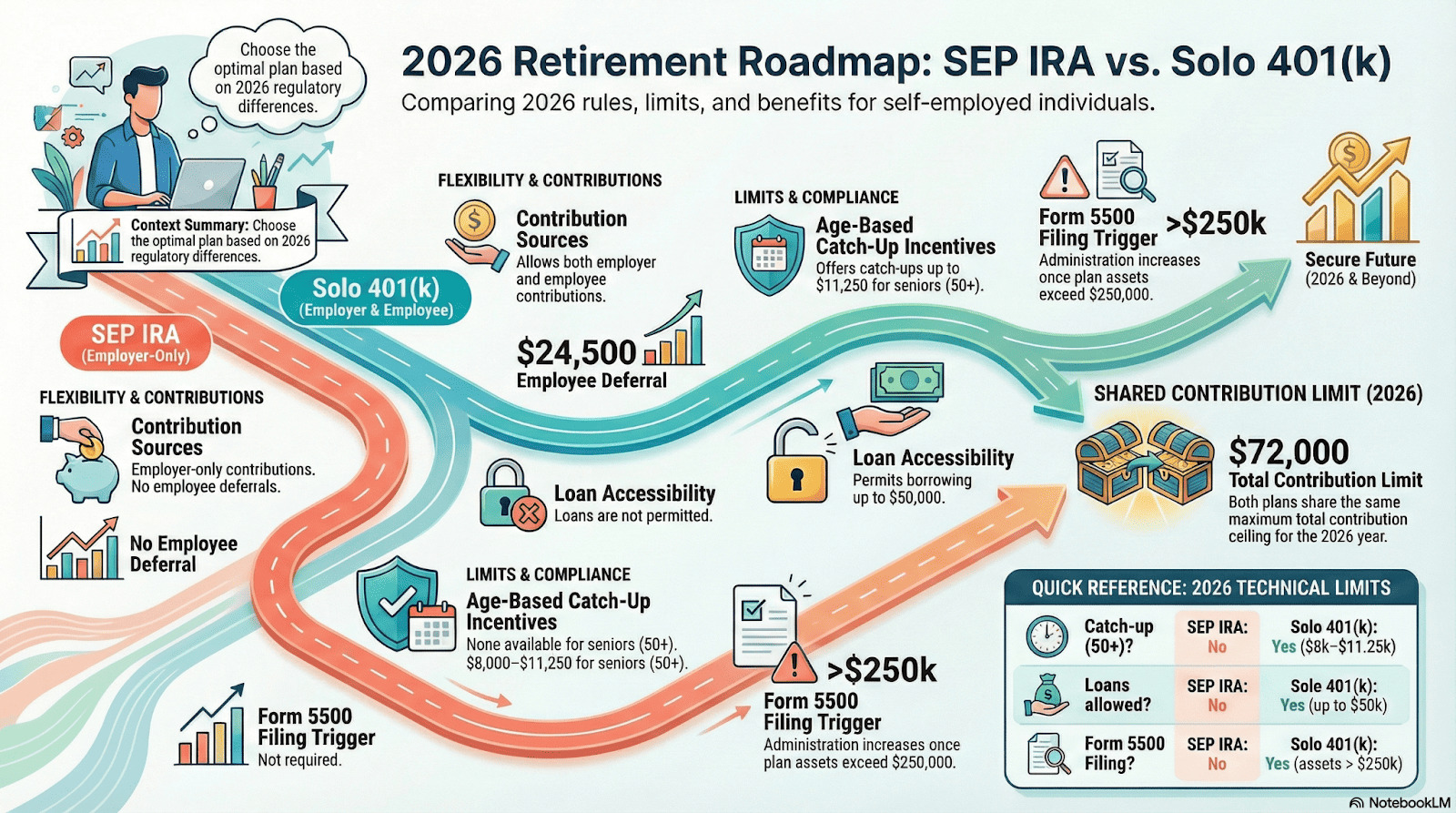
- The Solo 401(k) employee deferral limit shown in the infographic is $24,500.
- Both plans share the same total contribution limit of $72,000 for 2026.
- Solo 401(k)s allow participant loans of up to $50,000; SEP IRAs do not permit loans.
- Solo 401(k)s require Form 5500 filing once plan assets exceed $250,000; SEP IRAs do not have this filing requirement.
SEP IRA vs. Solo 401(k): What’s the Difference?
At a high level, a SEP IRA is simpler and works well for business owners who want an employer-funded retirement plan with minimal administration. A Solo 401(k), on the other hand, offers more flexibility and often allows higher contributions at lower income levels because it includes an employee deferral component.
The “better” option isn’t universal—it depends on how your income is earned and how much flexibility you want in your planning.
Contributions in 2026
One of the most important distinctions in 2026 is how contributions are structured.
With a SEP IRA, contributions are made only by the business and are based on a percentage of compensation. There is no employee deferral component.
With a Solo 401(k), contributions are split into two parts: employee deferrals and employer contributions. According to the infographic, the employee deferral limit is $24,500, and both plans share the same overall contribution cap of $72,000 for 2026.
This difference alone can materially affect how much you’re able to contribute, particularly if income is uneven or lower in certain years.
Catch-Up Contributions (Age 50+)
If you’re age 50 or older, catch-up contributions can play a meaningful role in retirement planning.
SEP IRAs do not offer catch-up contributions. Solo 401(k) plans do, and the infographic highlights enhanced catch-up incentives ranging from approximately $8,000 to $11,250, depending on age and eligibility.
For higher-earning self-employed individuals, this added flexibility can significantly increase total annual contributions.
Loans and Access to Funds
For some business owners, access to retirement funds is part of the decision. Solo 401(k) plans allow participants to borrow up to $50,000 from the plan, subject to standard loan rules. SEP IRAs do not permit loans under any circumstances.
While loans shouldn’t drive the decision on their own, this feature can matter for owners who value optional liquidity.
Form 5500 Filing Requirements
Administrative considerations also differ. A Solo 401(k) requires Form 5500 filing once plan assets exceed $250,000. SEP IRAs do not have this filing threshold, which can make them appealing for owners who prioritize simplicity.
That said, the added reporting requirement is often manageable and shouldn’t automatically rule out a Solo 401(k) if it’s otherwise the better planning fit.
Which Plan Is Right for You?
The right choice depends on income level, age, contribution goals, and how much flexibility you want. In general:
- A SEP IRA may make sense if you want simplicity and employer-only contributions.
- A Solo 401(k) is often better suited for owners who want higher contribution potential, catch-up options, and loan flexibility.
The key is choosing a plan that aligns with how your income is earned—not just what looks easiest to set up.
Work With a CPA Who Plans Ahead
Retirement planning is one of the most effective ways for self-employed individuals to reduce taxable income while building long-term wealth, but only if the plan is structured correctly and reviewed as income changes.
If you’re self-employed and want help choosing the right retirement plan for 2026, contact me to set up a no-obligation consultation.